Full AI Customer Service ROI Formula Breakdown: Costs, Savings, and Revenue Lift
AI Customer Service ROI is a payback model calculated on three axes: Total Cost of Ownership (TCO), labor hours saved, and increases in Average Order Value (AOV) and conversion rates. We track costs, calculate time savings, and estimate revenue lift to determine if the investment breaks even within 6 months.
Why is AI Customer Service ROI Hard to Calculate? The Three-Axis Split
Owners ask: “Is implementing AI customer service worth it?” Support managers respond: “It should save labor.” This isn’t enough for a decision because it lacks costs, baselines, and a recovery timeline. To make a call, we split it into three axes: Total Cost of Ownership (TCO), Hours Saved, and AOV or Conversion Lift.
Before: Only looking at the NT$5,000 monthly tool fee. After: Factoring in setup, models, integration, human review, and knowledge base maintenance to calculate monthly benefits. For the implementation sequence, see our Complete Guide to AI Customer Service Implementation.
We look at these axes separately because they answer different questions. TCO answers “How much will it cost to run stably?”; Hours Saved answers “How much repetitive work is eliminated?”; and AOV Lift answers “Does instant response bring new profit?” Many teams blur these into a single ROI percentage, leading to debates about tool quality rather than actionable metrics.
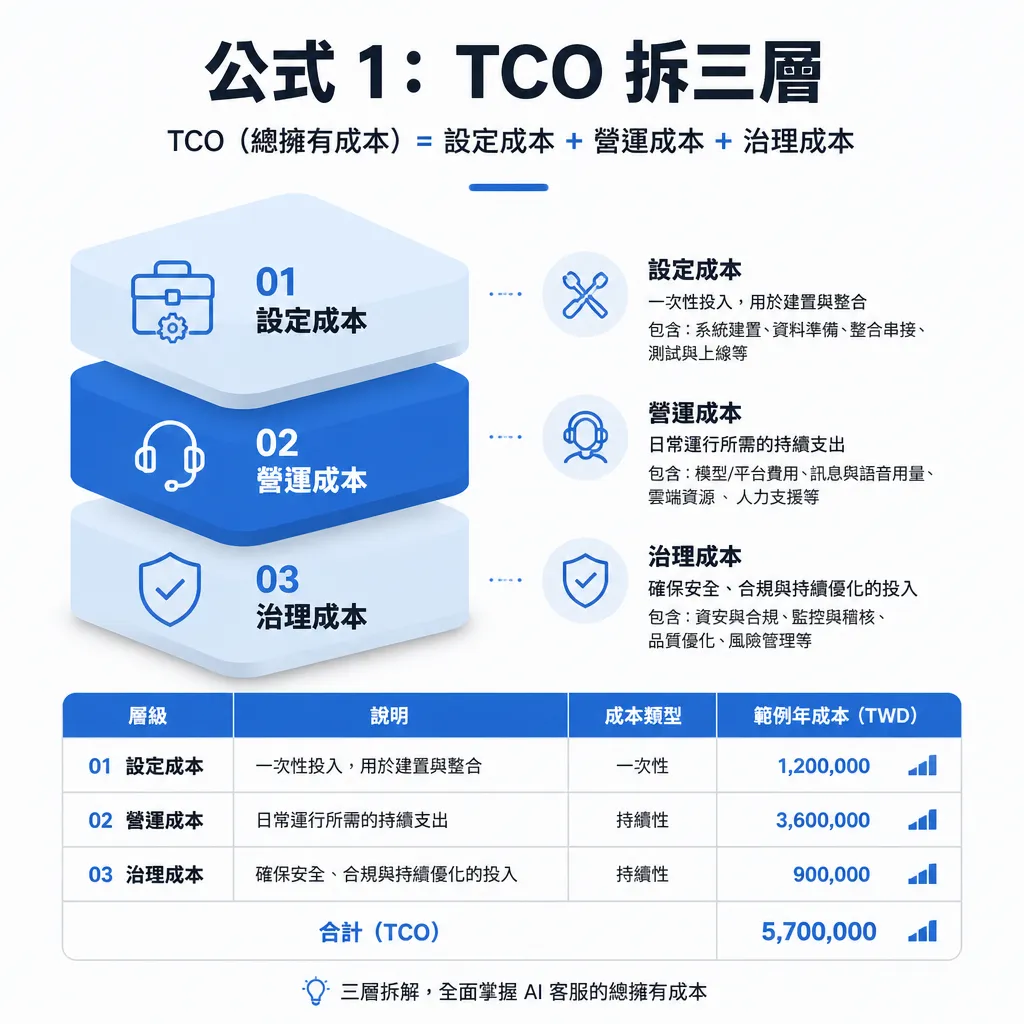
Formula 1: Total Cost of Ownership (TCO) = Setup + Operations + Governance
Formula: TCO = One-time Setup Cost + Monthly Operational Cost + Monthly Governance Cost. Setup includes workflows, FAQ, and system integration; Operations include SaaS, model APIs, and message volume; Governance includes human review, knowledge base maintenance, and tone calibration.
Monthly Cost for a 30-person E-commerce Team:
| Item | Amount | Description |
|---|---|---|
| Setup | NT$80,000 | Requirements, Knowledge Base, Integration |
| Operations | NT$12,000 | Models, Hosting, Message Volume |
| Governance | NT$8,000 | Review and Data Updates |
| Month 1 TCO | NT$100,000 | 80,000 + 12,000 + 8,000 |
| Recurring TCO | NT$20,000/mo | Operations + Governance |
Counting only subscription fees makes ROI look artificially high; including governance costs makes a 6-month recovery plan credible. See How to Calculate AI Adoption ROI for cost categorization.
Governance costs aren’t waste; they prevent AI from drifting. A 30-person e-commerce team typically reviews three types of logs weekly: questions handed over to humans, complaints or refund-related answers, and the final round of pre-sale conversations. If 4 hours of weekly review drops the error rate from 8% to 3%, that NT$8,000 governance fee is cheaper than handling post-sale refunds.
Setup fees should be amortized. If the company looks at a 6-month window, the NT$80,000 setup cost is NT$13,333/month; over a year, it’s NT$6,667/month. Short-term recovery focuses on cash flow; long-term usage focuses on net monthly benefits after amortization.
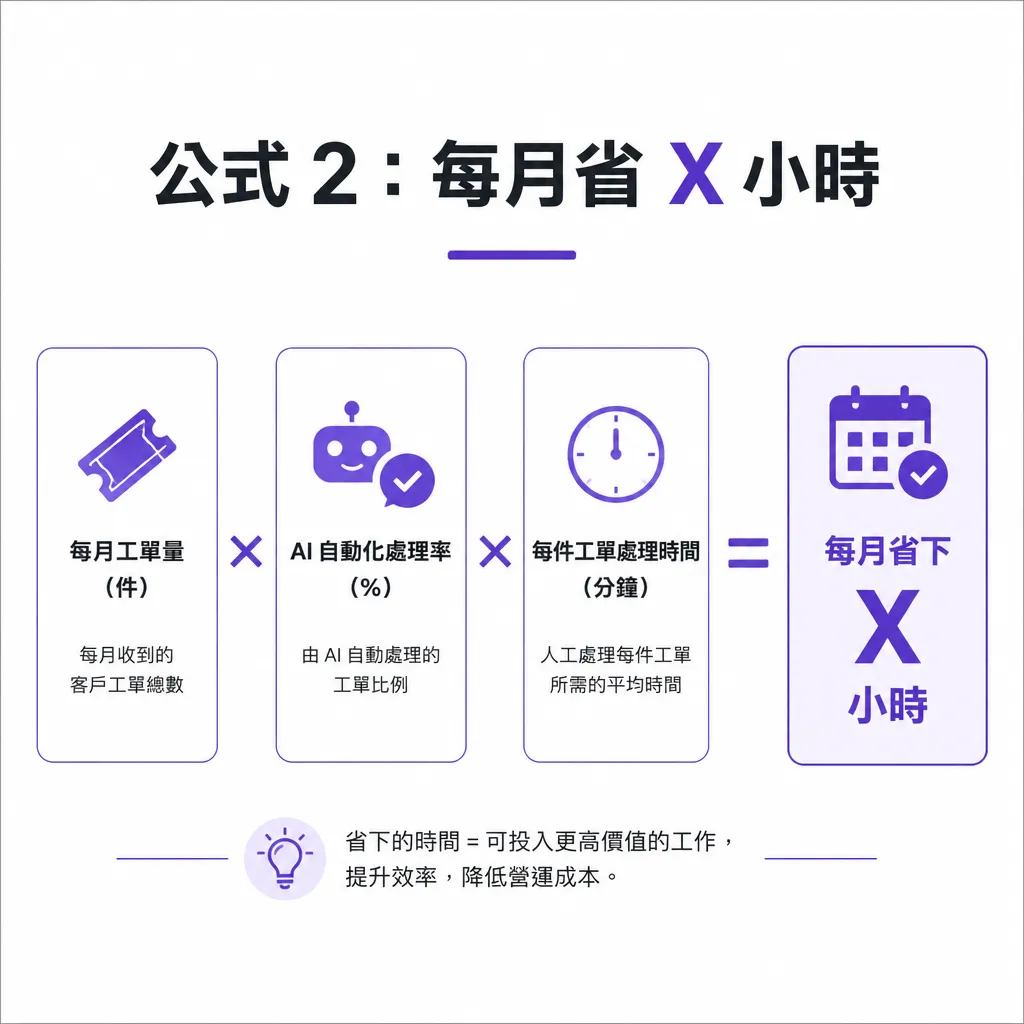
Formula 2: Hours Saved = Volume × Automation Rate × Time per Ticket × Hourly Wage
Formula: Monthly Savings = Monthly Ticket Volume × AI Full Automation Rate × Minutes per Ticket / 60 × Hourly Wage. SMBs often handle 1,500 to 2,500 tickets monthly. For logistics, returns, payments, inventory, and invoices, roughly 35% to 55% can be fully automated; we conservatively estimate 40%.
Assuming 6 minutes per ticket and a total human cost of NT$260/hour:
| Scale | Monthly Tickets | Automation Rate | Time Saved | Labor Savings |
|---|---|---|---|---|
| 30 People | 1,500 | 40% | 60 hours | NT$15,600 |
| 80 People | 2,500 | 45% | 112.5 hours | NT$29,250 |
| 200 People | 6,000 | 55% | 330 hours | NT$85,800 |
Saved time doesn’t mean immediate layoffs; we redirect staff to high-value consultations, following up on abandoned carts, and ticket classification. If you have an AI budget, integrate this with the AI Team ROI Breakdown.
Avoid two common data-padding traps. First, don’t count “AI drafted, human fully reviewed” as full automation; that’s just assisted savings. Second, don’t use peak weeks as the annual average. It’s safer to take a 3-month average and list peak season scenarios separately.
Automation rates should be layered: fully automated, AI drafted with human-in-the-loop, and AI triaged for human processing. Only the first layer yields full labor savings. The second layer usually reduces handling time by 30-50%, while the third layer’s value is in reducing routing errors. Mixing these up is the most common source of overestimated ROI.
Formula 3: AOV/Conversion Lift
The second recovery source isn’t labor reduction, but converting lost consultations into sales. Formula: Monthly Profit Increase = Monthly Consultations × Conversion Lift × Average Order Value (AOV) × Gross Margin. For a 30-person e-commerce team with 1,000 pre-sale consultations, NT$1,800 AOV, and 35% gross margin, moving conversion from 12% to 16% yields NT$25,200/month in profit.
This 12% to 16% is a trial assumption, not a guarantee. We only include four types of friction: waiting over 10 minutes, after-hours, weekends, and repetitive spec questions. This logic aligns with Zendesk CX Trends on 24/7 expectations and McKinsey State of AI 2025 on AI’s impact on costs and revenue. We track “AI-involved” vs. “non-AI-involved” conversion rates.
AOV Lift also comes from order value. If AI provides instant info on sizes, bundles, warranties, or accessories, and moves AOV from NT$1,800 to NT$1,900 for 120 AI-involved orders at 35% margin, that’s an extra NT$4,200/month. While small, it accelerates the break-even point when combined with conversion lift.
Combined: 6-Month Break-even Roadmap
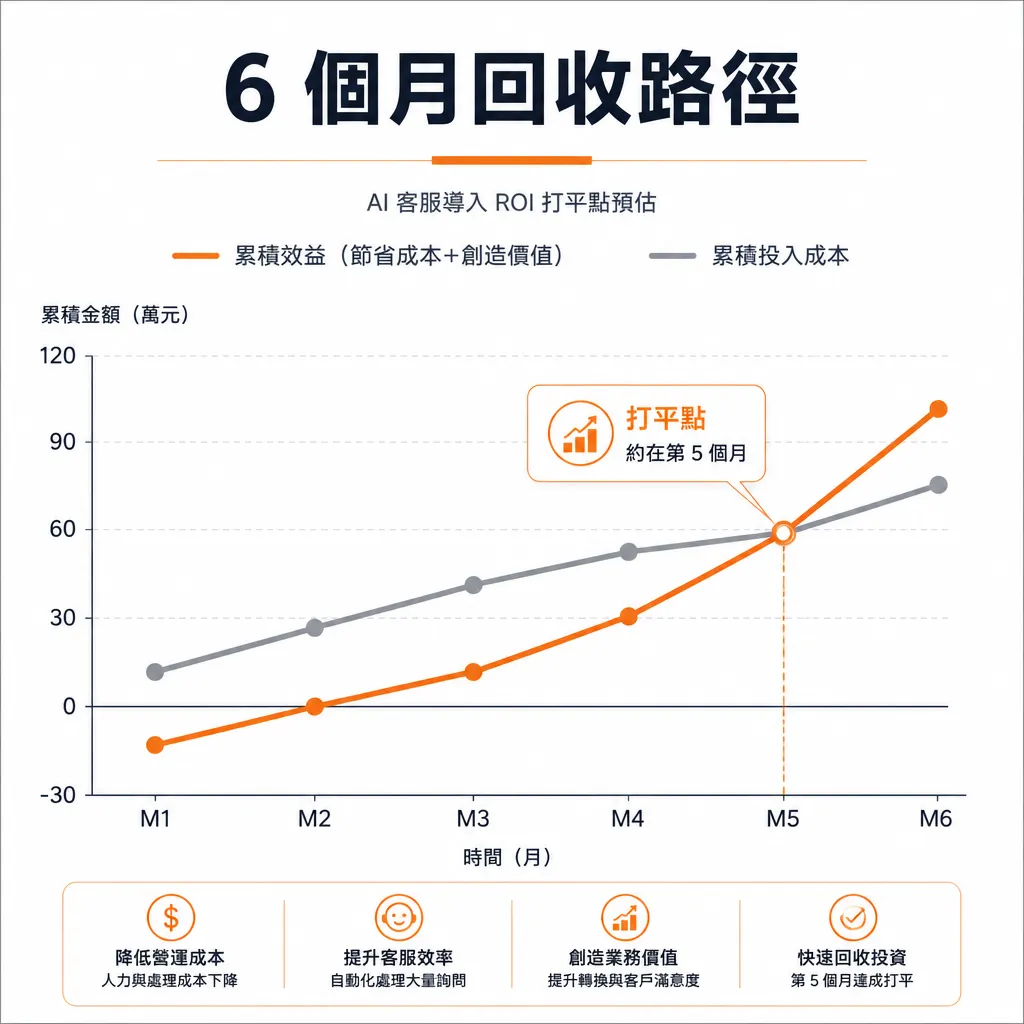
For a 30-person e-commerce team: Monthly Benefit = NT$15,600 (Labor) + NT$25,200 (Profit) = NT$40,800. Month 1 cost is NT$100,000, then NT$20,000/month; we recognize only 50% benefit in M1:
| Month | Cumulative Cost | Cumulative Benefit | Cumulative Net |
|---|---|---|---|
| M1 | NT$100,000 | NT$20,400 | -NT$79,600 |
| M2 | NT$120,000 | NT$61,200 | -NT$58,800 |
| M3 | NT$140,000 | NT$102,000 | -NT$38,000 |
| M4 | NT$160,000 | NT$142,800 | -NT$17,200 |
| M5 | NT$180,000 | NT$183,600 | NT$3,600 |
| M6 | NT$200,000 | NT$224,400 | NT$24,400 |
Turning positive in months 4 to 5 is common, provided volume is sufficient, the knowledge base is maintained, and AI captures pre-sale leaks. Before M2, without automation and conversion data, any ROI report is just a guess.
If M3 is still negative, we analyze which axis is dragging. If costs are over budget, we downgrade models or narrow the scope. If automation is low, we fix the knowledge base. If conversion hasn’t lifted, we check if AI is merely answering questions without prompting the next step. ROI management is about adjusting levers monthly, not just waiting 6 months for results.
SMB Real-world Example (30-person E-commerce)
Case: 1,500 tickets/mo, 6 mins/ticket, NT$260/hr, 40% automation. 1,000 consultations, NT$1,800 AOV, 35% margin, 12% to 16% conversion. Pain points: Peak slowness, no after-hours support, repetitive questions.
| Option | Monthly Cost | 6-Month Cost | Best Fit |
|---|---|---|---|
| No AI | NT$0 | NT$0 | Under 500 tickets/mo |
| SaaS Bundle | NT$5,000 | NT$30,000 | Fixed FAQ, low integration |
| AICycle Custom | Month 1 NT$100k, then NT$20k/mo | NT$200,000 | 1,500+ tickets/mo, ROI focused |
Use a SaaS for basic FAQs for 30 days. For integrating orders, members, products, tone, and conversion tracking, customized solutions provide better recovery potential. If you’ve struggled before, see the 5 Major Reasons for AI Adoption Failure.
The decision line is clear: if volume is low, avoid heavy integration. If managers are constantly firefighting due to high volume, cheap tools will fail at data silos. The value of AICycle isn’t just a “chatty bot” but a system connecting support, sales, knowledge, and dashboards.
Owners should look for stop-loss lines. We suggest fixing the knowledge base if automation is under 25% by Day 30; adjusting scripts if conversion hasn’t improved by Day 60; and narrowing the scope to high-margin processes if net value is under 50% of estimates by Day 90.
Pre-Mortem: 6 Blind Spots That Ruin ROI
- Dirty Knowledge Base: Clean the top 30 questions and high-risk terms first.
- Rigid Scripts: Keep a tone framework but let AI adjust to context.
- Untracked Handling Time: Sample and tag 100 tickets before launch.
- Ignored Review Time: Include manager review time in governance costs.
- Unlisted Refund Risks: Transfer warranty, refund, and discount issues to humans.
- Brand Voice Drift: Sample 30 messages weekly to check tone.
Perform a Pre-Mortem before signing. Assume ROI hasn’t met targets in 90 days, reverse-engineer the causes, and assign owners to each risk. Risks without owners eventually become “everyone knows, no one handles.”
FAQ
Q1: How many months until SMBs see ROI?
Direction by 30 days, trends by 90 days, and a break-even judgment between 4-6 months.
Q2: Is a SaaS package or custom solution better?
If tickets are under 500/mo and focused on FAQs, use SaaS. If over 1,500/mo and you need to link orders, members, and conversion rates, go custom.
Q3: What if ROI isn’t meeting targets?
Check the three axes: are costs over budget? Is automation under 35%? Has conversion lift stalled? Fix the specific axis or switch scenarios.
Q4: Do we need an AI engineer for ROI?
Not necessarily. Early stages need support managers, ops, marketing, and data owners. Engineers handle connections; ROI comes from workflows and metrics.
Q5: Does AI customer service increase brand risk?
Yes, if there are no review and escalation rules. We mark high-risk intents like warranties, refunds, and legal promises for human-in-the-loop processing.
Further Reading
- Complete Guide to AI Customer Service Implementation
- AI Team ROI Breakdown
- How to Calculate AI Adoption ROI
- 5 Major Reasons for AI Adoption Failure
- Clinic AI Automation Case Study
AI Customer Service ROI is manageable if it’s measurable. Put volume, handling time, automation, and conversion in one table. To turn your support into a trackable AI automation force, book a discussion on the AICycle Service Page.
A profitable implementation doesn’t just replace people; it ensures every ticket leaves improvable data, making next month cheaper, faster, and more effective at closing sales.